Sacred Crossings: What Lepcha Transition Rituals Reveal About the Art of Letting Go and Moving Forward
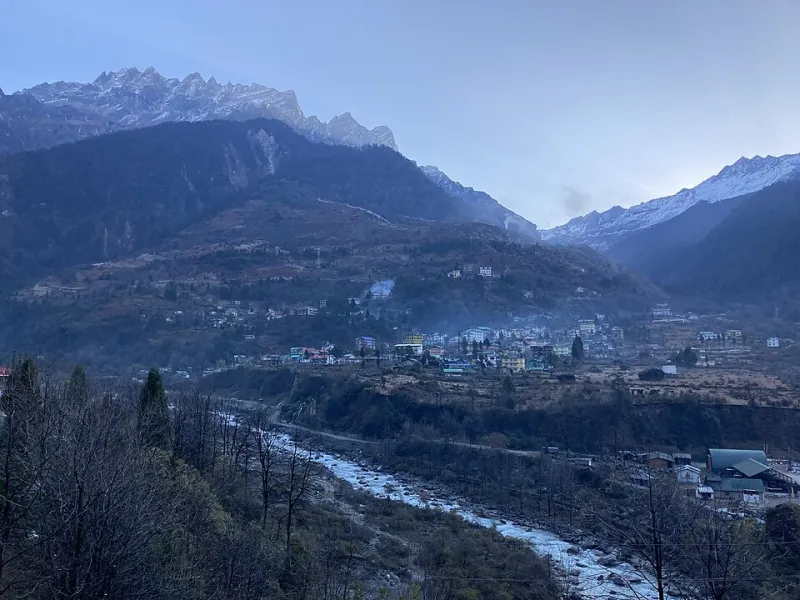
Photo: Mananjpatel1996, CC BY 4.0, via Wikimedia Commons
There is a particular kind of anxiety that defines contemporary American life—the feeling of being perpetually mid-crossing, suspended between what was and what has not yet arrived. Career pivots, cross-country relocations, the dissolution of long-held relationships, the arrival of parenthood, the departure of children: modern life serves up transitions at a pace that leaves little room for processing. Self-help culture responds with frameworks, productivity systems, and five-step plans. The Lepcha people of the Eastern Himalayas respond with ceremony.
For the Lepcha, a community whose homeland spans the mountainous regions of Sikkim, Darjeeling, and Bhutan, transitions are not interruptions to ordinary life. They are, in a very real sense, the most important moments of life—thresholds that demand acknowledgment, preparation, and ritualized passage. Understanding how this worldview operates, and why it has sustained a people through centuries of ecological and political upheaval, offers modern readers something that no productivity application can provide: a philosophy of change rooted in the recognition that transformation is inherently sacred.
The Threshold as a Living Space
In Lepcha cosmology, the concept of a threshold extends far beyond the physical doorway of a home, though that doorway is itself treated with considerable spiritual seriousness. Traditional Lepcha households observe specific protocols around entry and exit, particularly during ceremonially significant periods. The act of crossing into a home after a death, a birth, or a long journey is not performed casually. It is accompanied by gestures, words, or small offerings that acknowledge the weight of what the crossing represents.
This attention to physical thresholds reflects a broader metaphysical principle: that boundaries between states of being are not empty spaces but active zones, inhabited by spiritual significance. The Lepcha understanding holds that the moment of transition itself—not simply what lies on either side—deserves full, conscious engagement. Where Western culture tends to rush through the discomfort of change toward the stability promised on the other side, Lepcha tradition insists on dwelling, however briefly, in the passage itself.
The implications of this distinction are profound. When change is understood as a threshold rather than a disruption, the experience of uncertainty is reframed entirely. Uncertainty is no longer evidence that something has gone wrong. It is, instead, confirmation that something genuinely important is underway.
Marking Time, Marking Self
The Lepcha ceremonial calendar is organized, in significant part, around the transitions between seasons—moments when the ecological world itself is understood to be crossing from one state to another. These seasonal rites are not merely agricultural in character, though they are deeply connected to the rhythms of planting, harvest, and rest. They are also personal and communal acknowledgments that the human community is moving through time alongside the natural world, not apart from it.
Participation in seasonal transition ceremonies serves a function that modern psychology would recognize as deeply adaptive: it provides a structured container for the experience of change. Rather than facing the psychological weight of seasonal shift—the end of warmth, the onset of cold, the uncertainty of what the coming months will bring—as isolated individuals, Lepcha community members face it together, within a framework that has been refined across generations.
American culture, by contrast, tends to privatize the experience of transition. The new year arrives with fireworks and individual resolutions, but the deeper work of releasing what the previous year held and genuinely preparing for what comes next is largely left to each person to navigate alone. The Lepcha model suggests that this privatization may be part of what makes transitions feel so destabilizing: without communal ritual, the crossing is undertaken without a map and without companions.
Life Stages and the Grammar of Passage
Perhaps the most instructive dimension of Lepcha transition philosophy concerns the rites that accompany major life-stage changes. Birth, the passage into adulthood, marriage, and death are each attended by ceremonies that serve a dual purpose: they mark the individual's movement from one social and spiritual identity to another, and they engage the broader community as witnesses and participants in that movement.
This communal witnessing is not merely symbolic. In Lepcha tradition, transitions are understood to be incomplete without acknowledgment from the community. The individual who has moved from one stage to another must be seen in their new identity by those who knew them in their previous one. This recognition is what consolidates the crossing—what makes it real.
Consider how differently major life transitions tend to function in contemporary American society. A person who has left a long career, survived a serious illness, or emerged from a difficult divorce may feel profoundly changed, yet find that the world around them continues to interact with them as though nothing has shifted. The internal transformation remains unwitnessed, and therefore, in some essential way, unconfirmed. The Lepcha ceremonial tradition addresses precisely this gap—not through grand gestures, but through the consistent insistence that change must be acknowledged collectively to be fully inhabited.
Preparation as Spiritual Practice
One of the most counterintuitive aspects of Lepcha transition ritual is the emphasis placed on preparation—not logistical preparation, but spiritual and psychological readiness. Before a significant threshold is crossed, whether the beginning of a planting season, a child's passage into a new life stage, or a community's movement through a period of collective grief, Lepcha tradition prescribes periods of reflection, purification, and intentional release.
This preparatory phase is understood as the work of making oneself genuinely available for what is coming. It is not enough to arrive at a threshold; one must arrive having set down, as deliberately as possible, what belongs to the space being left behind. The Lepcha do not regard this as a simple or natural process. It is work—sometimes difficult, sometimes lengthy—and it is treated with corresponding seriousness.
For Americans accustomed to moving rapidly from one chapter to the next, this emphasis on conscious release represents a genuine challenge. The cultural pressure to demonstrate resilience, to pivot quickly and present a forward-facing posture, actively discourages the kind of deliberate leave-taking that Lepcha tradition regards as essential. What gets bypassed in that rush, the Lepcha worldview suggests, does not disappear. It follows the traveler across the threshold and complicates whatever waits on the other side.
What the Crossing Asks of Us
The wisdom embedded in Lepcha transition philosophy is not esoteric. It does not require adoption of an unfamiliar spiritual tradition or rejection of one's own. What it asks, rather, is a fundamental shift in orientation: toward transitions as events worthy of full attention, toward community as an essential participant in individual change, and toward the threshold itself as a space that deserves to be inhabited rather than escaped.
In a country where change is simultaneously celebrated as progress and experienced as loss, the Lepcha model offers something rare—a framework in which both of those truths can coexist without contradiction. The crossing is real. What is being left behind is real. What lies ahead is real. And the passage between them, however uncomfortable, is not a problem to be solved. It is, the Lepcha tradition quietly insists, precisely where the most important work of a human life takes place.