How a Himalayan Language Encodes Respect Into Every Request
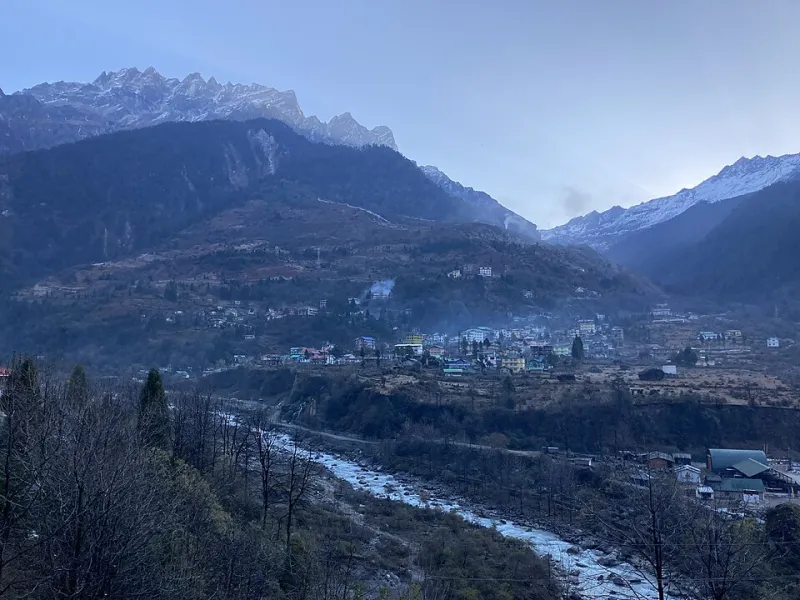
Photo: Mananjpatel1996, CC BY 4.0, via Wikimedia Commons
Most of us learned to make requests long before we understood what a request actually is. We were taught to say "please" and "thank you," to soften commands with a rising intonation, to frame instructions as questions. Yet beneath these social veneers, the underlying logic of English often remains transactional: one party needs something, another party is expected to provide it, and the verbal packaging is simply a matter of decorum.
The Lepcha language, spoken by the indigenous Lepcha people of the Sikkim region in the eastern Himalayas, takes a fundamentally different approach. Here, the architecture of asking is not ornamental — it is structural. Consent, relationship, and the dignity of the person being addressed are not layered on top of a request; they are built into its grammatical bones.
The Grammar of Consent
Linguists who have studied Lepcha — a Tibeto-Burman language with its own ancient script — note that the language does not possess a robust imperative mood in the way that English does. Where English speakers can issue a direct command with relative ease ("Close the door," "Send me that file," "Eat your vegetables"), Lepcha speakers navigate a more nuanced grammatical terrain. Requests are typically constructed using forms that embed the possibility of refusal. The linguistic scaffolding of a Lepcha request acknowledges, at the level of grammar itself, that the person being addressed retains agency.
This is not simply a matter of adding softening particles the way a speaker of Japanese or Korean might. Rather, the entire framing of the utterance positions the speaker as someone presenting an opportunity for cooperation rather than issuing an instruction that requires compliance. The relationship between speaker and listener is not that of transmitter and receiver — it is closer to that of two parties engaged in a negotiation whose outcome is genuinely open.
For American readers accustomed to workplace cultures built around directives, or family dynamics shaped by hierarchical authority, this may sound inefficient. In practice, speakers of Lepcha and researchers who have spent time in Lepcha communities describe something quite different: a social environment in which cooperation tends to emerge more organically, in part because the asking itself does not create resistance.
When the Ask Is Not a Transaction
Consider what happens when a request is framed as a demand, even a politely worded one. The recipient of that demand — a child, a colleague, a partner — is placed in a position where compliance is the expected outcome. Refusal carries social cost. Even when the person technically has the freedom to say no, the grammar of the situation has already weighted the scales.
Lepcha linguistic practice disrupts this dynamic. Because the grammatical form of a request in Lepcha genuinely leaves space for the other person's response, the act of asking becomes a relational event rather than a transactional one. The speaker is not simply extracting a service — they are initiating a moment of connection whose outcome will reflect the state of the relationship between them.
This has observable effects on community life. Anthropologists and cultural researchers who have documented Lepcha social practices describe a notably low incidence of overt interpersonal conflict, and attribute this in part to communication norms that reduce the conditions under which people feel coerced or disrespected. When the language itself makes it difficult to demand, the culture has fewer demands to resist.
Practical Implications for American Life
The United States is currently living through a prolonged conversation about power, authority, and communication. In workplaces, organizations are grappling with how to move from top-down management toward cultures of genuine collaboration. In schools, educators are debating the merits of authoritative versus authoritarian approaches to classroom management. In homes, parents are searching for ways to guide children without simply overriding their developing sense of autonomy.
The Lepcha model does not offer a simple script. You cannot transplant a grammatical structure from one language into another and expect the social effects to follow automatically. But the underlying principle — that the form of an ask shapes the nature of the relationship — translates with remarkable clarity.
Consider the difference between "I need this report by Friday" and "Would it be possible to have the report by Friday, or is there a timeline that works better for you?" The second formulation is longer. It is also, in most workplace contexts, more likely to produce a thoughtful, honest response — and a result that both parties feel ownership over. This is not weakness; it is precision. You are asking for what you actually want: genuine cooperation, not reluctant compliance.
Similarly, in parenting contexts, research in developmental psychology has long supported what Lepcha linguistic culture embeds at the grammatical level: children who are given genuine choices and whose agency is acknowledged tend to develop stronger intrinsic motivation and more reliable cooperative behavior than children who are primarily managed through commands.
The Relationship Behind the Words
There is a deeper dimension to Lepcha request culture that goes beyond grammar. In Lepcha communities, the act of asking is understood to carry relational weight. To ask someone for something is to acknowledge your dependence on them, which in turn acknowledges their value. This is not a burden — it is a form of recognition.
In a culture that often prizes self-sufficiency to the point of treating need as embarrassing, this reframing is genuinely countercultural. The Lepcha practice suggests that asking well — asking in a way that honors the other person's capacity to respond freely — is itself a form of respect. It says: I see you as someone whose yes means something, precisely because your no is also possible.
This has implications not only for how we ask others for things, but for how we understand the requests made of us. When we receive a request that is genuinely open — one that creates space for our honest response — we are being treated as full participants in a relationship rather than as instruments of someone else's agenda.
A Language Worth Learning From
The Lepcha language is endangered. Estimates suggest that fewer than 50,000 people speak it with any fluency, and the pressures of dominant regional languages, economic migration, and cultural assimilation have placed it under considerable strain. Efforts to document, preserve, and revitalize Lepcha are ongoing, and the work of linguists, community members, and cultural organizations remains critically important.
But the ideas embedded in Lepcha linguistic structure do not require fluency to be meaningful. They require attention — the kind of attention that asks: What am I actually doing when I ask for something? Am I creating space for a genuine response, or am I simply packaging a demand in more acceptable wrapping?
From the roof of the world, the Lepcha language offers a quiet but precise answer. Asking well is not a courtesy. It is a commitment to the person you are asking — and to the relationship that makes asking possible at all.