Ancient Letters, Modern Screens: The Quiet Revolution to Save the Lepcha Writing System
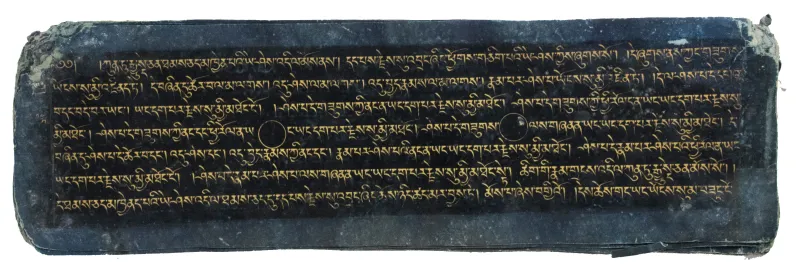
Photo: Himalayan manuscript ancient script handwritten letters traditional, via inlibris.com
For most Americans, the concept of a writing system facing extinction feels abstract — something confined to history textbooks or documentary films about distant civilizations. Yet for the Lepcha people of the Himalayan region, the survival of their indigenous script is an urgent, living concern. The Rongker script, developed roughly three centuries ago, is not a relic. It is a breathing archive of a people's identity, spiritual life, and ecological knowledge. And right now, it is at the center of one of the most compelling language preservation efforts in the world.
What Is the Rongker Script?
The Rongker script — sometimes referred to simply as the Lepcha script — is an abugida, a writing system in which consonants carry an inherent vowel sound that can be modified through diacritical marks. Scholars attribute its creation to Thikung Men Sallong, a revered Lepcha scholar, sometime in the early eighteenth century. Unlike many writing systems of the region, Rongker was developed specifically for the Lepcha language, known natively as Róng, making it a uniquely organic expression of that linguistic tradition.
The script flows with a graceful, curvilinear aesthetic that reflects the natural world the Lepcha people have long inhabited. Its characters are said to draw visual inspiration from the flora and fauna of Sikkim and the surrounding Himalayan foothills — a design philosophy that mirrors the Lepcha worldview, in which human life is inseparable from the natural environment.
Despite its cultural significance, the script suffered severe decline throughout the nineteenth and twentieth centuries. Colonial administration, the dominance of Nepali and English in formal education, and the political marginalization of Lepcha communities all contributed to a dramatic reduction in the number of people who could read or write Rongker fluently.
The Digital Challenge
Reviving a non-Roman script in the digital age is far more complex than simply creating a font. Every writing system that appears on a screen — from the Latin alphabet used in English to the Devanagari script used in Hindi — must be encoded within a global technical standard known as Unicode. Without a Unicode designation, a script cannot be reliably rendered across devices, operating systems, or web browsers.
The Lepcha script was formally assigned a Unicode block in 2005, a milestone that opened the door to digital representation. However, encoding a script is only the beginning. Keyboards must be designed, input methods must be standardized, and fonts must be created that accurately render the script's full range of characters — including its complex conjunct consonants and vowel diacritics.
Lepcha linguists and technology advocates have worked in collaboration with international organizations, including the Endangered Archives Programme at the British Library, to digitize historical manuscripts written in Rongker. These projects have produced searchable digital repositories that scholars around the world can now access. For a community whose written heritage was once confined to fragile palm-leaf manuscripts stored in monasteries, this represents a transformative development.
Yet significant gaps remain. Many of the fonts currently available for Rongker do not fully support all character combinations, and keyboard input tools are not yet widely distributed or user-friendly enough for everyday use. Developers working on these tools often operate with limited funding, relying on volunteer labor and small grants rather than the institutional backing that supports more widely spoken languages.
Teaching the Script to a New Generation
Technology alone cannot revive a writing system. Language lives in people, and the most consequential work of the Rongker revival is happening not in software development studios but in classrooms and community centers — including efforts that have extended into diaspora communities in North America and Europe.
In parts of Sikkim and Darjeeling, where the largest concentrations of Lepcha speakers live, community organizations have established supplementary language programs that teach Rongker alongside the state-mandated curriculum. These programs face a familiar set of obstacles: a shortage of trained teachers, limited instructional materials, and the practical pressure on young people to prioritize languages with greater economic utility.
Some educators have responded by integrating digital tools directly into the classroom. Mobile applications that teach Rongker characters through interactive exercises have been developed by community members, some of whom are self-taught app developers motivated by personal cultural commitment rather than professional training. Social media platforms have also become unexpected venues for Rongker instruction, with short video tutorials reaching Lepcha youth who might never attend a formal language class.
The emotional dimension of this work should not be understated. For many young Lepcha people, learning to read and write in Rongker is not merely an academic exercise. It is an act of cultural reclamation — a way of reconnecting with grandparents, with sacred texts, and with a vision of identity that resists assimilation.
What Linguistic Diversity Means for All of Us
From an American perspective, it might be tempting to view the Rongker revival as a story of purely local significance. In fact, the stakes are considerably broader. Linguists estimate that roughly half of the world's approximately 7,000 languages could disappear by the end of this century. Each lost language takes with it a unique framework for understanding the world — distinct concepts, ecological knowledge systems, and ways of organizing human experience that have no direct equivalent in any other tongue.
The Lepcha language, for instance, contains an extraordinarily rich vocabulary for describing the natural environment of the eastern Himalayas. Terms for specific microclimates, plant behaviors, and seasonal ecological transitions exist in Róng that have no precise translation in English or Nepali. As climate change reshapes that environment at an accelerating pace, this indigenous knowledge base carries genuine scientific value.
The Rongker revival is, in this sense, not only a cultural project but an intellectual one. It is an argument — made through patient, painstaking work — that the world is diminished when any language falls silent.
A Script That Refuses to Disappear
The story of Rongker's survival is, above all, a story of human determination. Against considerable odds — political, economic, and technological — a community has refused to allow its written heritage to become a museum artifact. The tools available to that community today, from Unicode standards to social media platforms, are more powerful than anything available to previous generations. Whether those tools will prove sufficient depends, in the end, on the choices of the Lepcha people themselves and on the degree to which the wider world chooses to recognize the value of what they are working to preserve.
For those of us outside the Lepcha community, the least we can offer is attention — and, perhaps, a renewed appreciation for the extraordinary diversity of human expression that still exists on this planet, waiting to be heard.