When Generosity Is the Grammar: How Lepcha Gift-Giving Rituals Offer a New Vocabulary for Life Beyond Consumerism
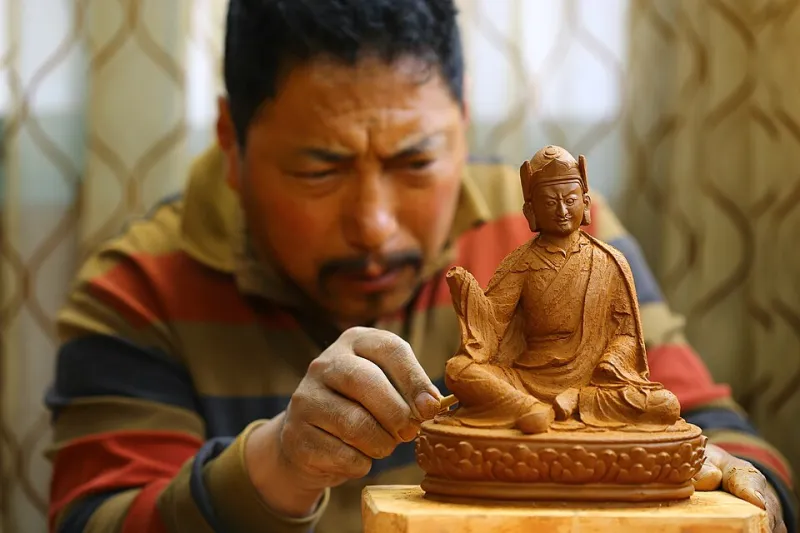
Photo: Dawa Drolma, CC BY-SA 4.0, via Wikimedia Commons
Every November, American households brace for what has become a peculiar cultural marathon: a sprint from Thanksgiving gratitude directly into Black Friday acquisition. The emotional whiplash is so familiar that it barely registers anymore. We give thanks, then we consume — and the gap between those two acts grows narrower each year. Against this backdrop, the gift-giving traditions of the Lepcha people of the eastern Himalayas offer something genuinely disorienting, in the best possible sense. They suggest that generosity and identity are not separate categories. In Lepcha culture, they are the same sentence.
The Ceremony Behind the Exchange
Among the Lepcha — an indigenous people indigenous to Sikkim, Darjeeling, and the surrounding Himalayan foothills — ritualized gift exchange is woven into the architecture of social life. These exchanges are not incidental gestures of politeness. They are formalized, ceremonially bounded acts that carry specific social and spiritual weight.
During festivals such as Tendong Lho Rum Faat, a harvest celebration honoring the sacred mountain Tendong, the movement of food, hand-crafted objects, and symbolic offerings between families and community members follows a deeply understood protocol. Who gives to whom, what is given, and in what sequence all carry meaning that extends far beyond the objects themselves. The gift is a relational statement — an affirmation that the giver and receiver are bound within a web of mutual obligation that predates both of them and will outlast both of them.
This is what anthropologists sometimes call "sacred reciprocity," but that academic phrase can flatten what is, in practice, a living and emotionally resonant tradition. For the Lepcha, giving is not philanthropic. It is participatory. It is how a person demonstrates that they understand their place within the community — not as an isolated economic agent, but as a node in a network of obligations that sustains everyone.
What Makes a Gift Sacred
In contemporary American culture, the word "gift" has become almost synonymous with "purchase." We speak of gift cards, gift budgets, and gift guides. The object itself — its monetary value, its brand, its wrapping — has become the primary carrier of meaning. The relationship between giver and receiver is, in many cases, secondary to the transaction.
Lepcha gift-giving inverts this hierarchy entirely. The object matters far less than the act, and the act matters far less than the intention behind it. Traditional Lepcha gifts — fermented millet beer (chhang), hand-woven textiles, food prepared from one's own harvest — are meaningful precisely because they carry the labor, care, and identity of the giver. They cannot be purchased at a store. They cannot be delegated. They are, in the most literal sense, a piece of the giver's life offered to another.
This is not merely sentimental. It reflects a coherent philosophical position: that what you give away is an extension of who you are, and that a community's health is measured by the quality and frequency of that extension. Hoarding, in this framework, is not just economically inefficient — it is a kind of social failure, a withdrawal from the grammar of communal life.
The Obligation That Isn't a Burden
American readers may initially bristle at the word "obligation." In a culture that prizes individual freedom and voluntary action, obligation can sound like coercion. But the Lepcha conception of mutual obligation is worth examining more carefully, because it operates on a different emotional register than the guilt-laden duty familiar to many Westerners.
In Lepcha society, the expectation of reciprocity is not experienced as a debt to be repaid but as a rhythm to be participated in. When a family receives assistance during a difficult harvest season, the understood expectation is not that they will repay a specific amount at a specific time. Rather, they will, when their own circumstances allow, extend similar generosity to others — perhaps not even to the same family. The obligation circulates. It is communal rather than bilateral.
This distinction matters enormously. It transforms giving from a zero-sum calculation into something closer to a subscription to community membership. The American reader who has ever felt exhausted by the transactional quality of holiday gift exchanges — the mental accounting of who gave what, who owes whom — may recognize in the Lepcha model a system that sidesteps that exhaustion almost entirely.
Identity Embedded in Generosity
Perhaps the most striking aspect of Lepcha gift-giving culture is what it implies about personal identity. In much of mainstream American consumer culture, identity is expressed through acquisition — what we own, what we wear, what we display. The Lepcha tradition suggests an alternative: that identity is expressed through what we give away and how we give it.
Elders within the community are often distinguished not by their material accumulation but by their reputation as generous participants in the gift economy. To be known as a generous person — someone who gives freely, who participates actively in ceremonial exchange, who does not calculate the return before offering — is to hold a form of social prestige that no purchase can replicate.
This is not unique to the Lepcha; similar patterns appear in many indigenous gift economies around the world. But the Lepcha articulation of this principle is particularly coherent, embedded as it is within a broader worldview that understands humans as fundamentally relational beings rather than autonomous individuals.
A Framework, Not a Prescription
None of this is to suggest that American readers should attempt to replicate Lepcha ceremonial practices wholesale, nor that the Lepcha tradition is without its own internal complexities and tensions. Cultural traditions are not transferable software packages. They are living systems shaped by specific ecologies, histories, and cosmologies.
What the Lepcha gift-giving tradition does offer, however, is a coherent philosophical counterweight to the consumer logic that dominates so much of American social life. It demonstrates that another way of organizing generosity, identity, and community is not only possible but has been practiced with sophistication for generations.
For the American reader standing in a checkout line in late November, surrounded by the machinery of acquisition, that demonstration alone carries considerable weight. It suggests that the discomfort many people feel about the transactional quality of modern life is not mere nostalgia or naivety. It is, perhaps, a recognition that something genuinely important has been structured out of our social grammar — and that recovering it might begin not with a purchase, but with the deliberate, unhurried act of giving something of ourselves away.
The Lepcha have been speaking this language from the roof of the world for a very long time. We are only beginning to learn to listen.