Reading the Mountain Like a Text: The Lepcha Science of Finding Your Way Without a Map
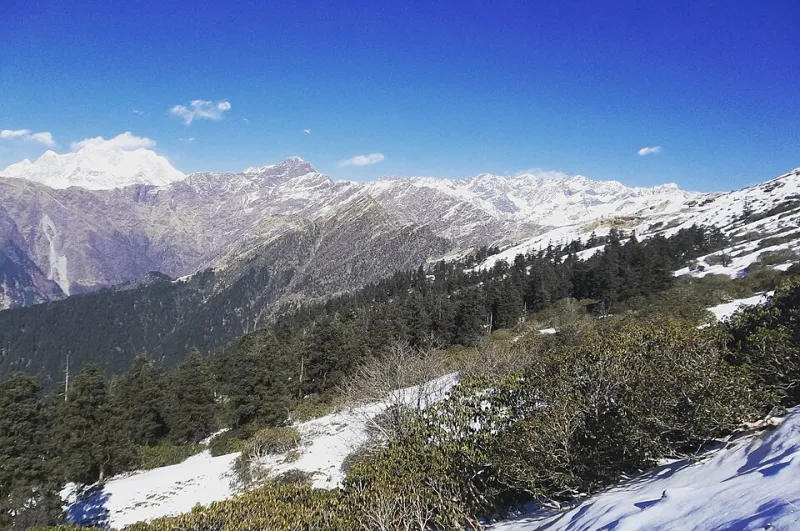
Photo: Mohammed Shafiyullah, CC BY-SA 4.0, via Wikimedia Commons
Somewhere in the layered folds of the eastern Himalayas, where Sikkim's ridgelines dissolve into cloud and the rivers below carve their own logic through ancient rock, a Lepcha elder can tell you precisely where you are—not by consulting a device, but by listening. To the sound of water moving over particular stones. To the angle at which morning light strikes a specific cliff face. To the particular species of moss clinging to the north side of a boulder at a known elevation. For the Lepcha, the landscape is not a backdrop. It is a document, and they have spent centuries learning to read it.
This form of indigenous spatial intelligence—sometimes called ethnographic wayfinding in academic literature, though that phrase scarcely captures its depth—is among the most sophisticated and least understood cognitive systems produced by any culture on earth. As neuroscientists in the United States increasingly explore how the human brain constructs spatial memory, and as wilderness educators debate the consequences of GPS dependency among a generation of hikers who struggle to orient themselves without a signal, the Lepcha tradition of landscape literacy offers a striking and instructive counterpoint.
A Language That Thinks in Terrain
Any serious examination of Lepcha wayfinding must begin with the language itself, because Lepcha spatial knowledge is not merely practiced—it is spoken. The Lepcha language, a Tibeto-Burman tongue with its own ancient script, contains a remarkable density of vocabulary dedicated to describing topographical features, hydrological patterns, and microecological conditions. Where English offers a handful of generic terms—valley, ridge, slope—Lepcha distinguishes between dozens of terrain configurations, each carrying navigational and ecological significance.
The language encodes directionality not in the abstract cardinal terms most Americans learn in grade school—north, south, east, west—but in relation to watershed dynamics. In Lepcha spatial grammar, orientation is frequently expressed relative to the flow of water: upriver and downriver serve as primary axes of movement, with lateral directions calibrated accordingly. This hydrological orientation is not merely poetic. In a landscape defined by rivers descending from glacial heights, knowing where the water runs is knowing where you are.
Linguists who have studied Lepcha note that this water-centered spatial logic is embedded grammatically, not just lexically. It shapes how speakers describe movement, how they give directions, and how they remember routes. To a native Lepcha speaker, a path is not described as going "north for two miles and then turning east." It is described in relation to drainage patterns, vegetation transitions, and named landmarks that carry ecological meaning. The route, in other words, is inseparable from the living environment through which it passes.
Seasonal Markers and the Moving Map
One of the most conceptually striking aspects of Lepcha wayfinding is its temporal dimension. Western cartography tends to produce static representations of space—a map made in one season is presumed serviceable in another. Lepcha spatial knowledge, by contrast, is explicitly seasonal. The landscape itself is understood to shift, and the skilled navigator shifts with it.
Certain flowering plants bloom at predictable elevations during specific months, functioning as altitude markers. The calls of particular bird species indicate proximity to forest edges or water sources. The direction in which certain grasses bend under prevailing winds provides compass information without a compass. These are not isolated tricks or folk shortcuts. They constitute an integrated system in which biological, meteorological, and geological phenomena are read simultaneously and cross-referenced against one another.
Elders within the Lepcha community describe this capacity not as memorization but as a cultivated form of attention—a trained sensitivity to the environment that develops over years of deliberate observation. Young Lepcha learners are not handed a list of rules to memorize. They are taken into the landscape repeatedly, in different seasons and different weather, and taught to notice. The pedagogy is immersive and relational, premised on the idea that landscape knowledge cannot be abstracted from the experience of moving through a landscape.
What Neuroscience Is Only Beginning to Understand
Recent decades have seen a surge of scientific interest in what researchers call "allocentric" spatial cognition—the ability to navigate by constructing a mental map of the environment relative to fixed external landmarks, rather than relative to one's own body position. Studies at institutions including MIT and University of California campuses have found that this form of spatial reasoning is associated with robust hippocampal activity and appears to confer navigational advantages in complex, unfamiliar terrain.
The Lepcha system, though it has not yet been the subject of formal neuroscientific study, appears to cultivate precisely this allocentric orientation—and to do so through a lifetime of practice embedded in daily life and language. The implications are significant. Research on London taxi drivers famously demonstrated that extensive navigation experience produces measurable changes in hippocampal structure. If a comparable study were designed around Lepcha wayfinding practice, the results could meaningfully advance our understanding of how environmental immersion shapes the navigating brain.
There is also the question of what is lost. Researchers studying GPS dependency in American college students have documented a phenomenon sometimes called "navigation offloading"—the tendency to surrender spatial reasoning to a device, with measurable consequences for independent wayfinding ability. Against this backdrop, the Lepcha tradition raises an urgent question: what cognitive capacities are we collectively allowing to atrophy, and at what cost?
The Conservation Dimension
For environmentalists and conservation practitioners, Lepcha landscape literacy carries a different but equally compelling significance. The Lepcha have long been recognized as expert stewards of the forests and watersheds of Sikkim, a relationship formalized in part through their designation of certain areas as sacred groves, or Mayel Lyang—literally, "the hidden paradise." Their capacity to navigate and monitor these landscapes is inseparable from their capacity to protect them.
When Lepcha community members detect changes in the landscape—a stream running shallower than expected, a particular plant species appearing at an unusual elevation, a bird absent from a zone where it has always been present—these observations are navigational data and ecological data simultaneously. The wayfinder and the conservationist are, in the Lepcha tradition, the same person performing the same act of reading.
Conservation organizations operating in the broader Himalayan region have increasingly recognized the value of integrating this kind of indigenous environmental knowledge into monitoring frameworks. The challenge lies in doing so in ways that respect Lepcha intellectual sovereignty and do not reduce a living knowledge system to a database of extracted data points.
A Different Kind of Literacy
In the United States, the word "literacy" has expanded well beyond reading and writing to encompass digital literacy, financial literacy, and ecological literacy. The Lepcha tradition of landscape reading suggests yet another dimension: a form of environmental literacy so comprehensive and so finely calibrated that it constitutes, in effect, a science of place.
This is not romanticism. The Lepcha system has been tested against one of the most demanding environments on earth and refined over generations. It encodes genuine empirical knowledge—about hydrology, ecology, meteorology, and terrain—in a form that is simultaneously linguistic, embodied, and communal. It is knowledge that GPS cannot replicate, not because technology is inadequate, but because this knowledge is not merely locational. It is relational. It is a way of being in a landscape, not simply of finding one's coordinates within it.
For American readers accustomed to reaching for their phones the moment they feel uncertain about direction, that distinction is worth sitting with. The Lepcha do not navigate despite their environment. They navigate through it—and in doing so, they remind us that the most sophisticated map ever made is the one the living world itself provides, for those patient and attentive enough to learn to read it.