Thread That Remembers: What Lepcha Weavers Know That Fast Fashion Forgot
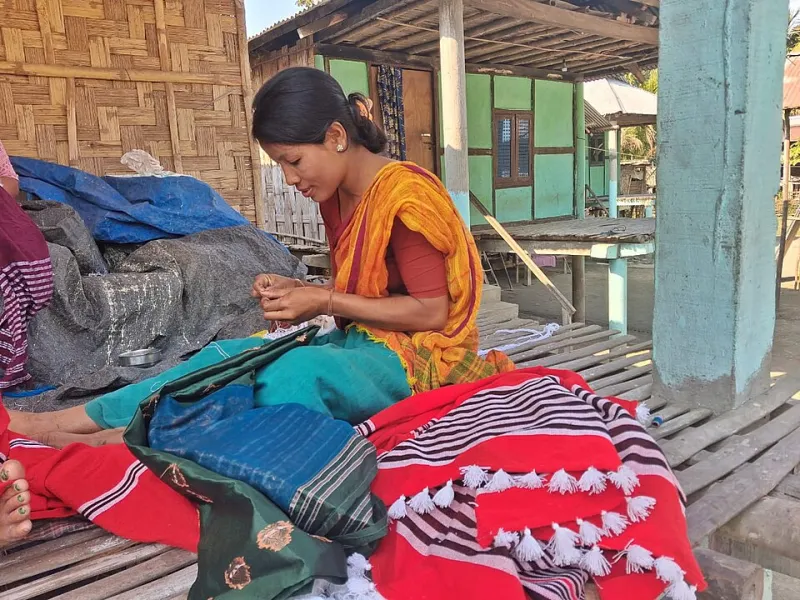
Photo: পাপৰি বৰা, CC BY-SA 4.0, via Wikimedia Commons
The average American discards roughly 80 pounds of clothing per year, much of it worn a handful of times. We know the numbers. We recycle a tote bag's worth of guilt, buy a capsule wardrobe we mostly ignore, and return, each season, to the same checkout button. The slow fashion movement has diagnosed this thoroughly. What it has struggled to produce is a working alternative — an economy where clothes carry meaning instead of markdowns.
It may help to look at a place where the alternative never stopped operating.
The Garment as Archive
Traditional Lepcha textile work — hand-woven fabrics from nettle, cotton, and wool, worn through the cold Himalayan months — operates on a logic alien to fast fashion. Cloth was made slowly, close to home, from fibers people could name. A woven garment marked identity, occasion, and region. It was repaired, re-woven, and passed along. To wear it was to wear a history you could trace.
This is not nostalgia; it is information economics. When you know the weaver, the fiber, and the months of labor in a cloth, you do not treat it as disposable. Disposability is not a human constant — it is what happens when clothing becomes anonymous.
Why the Fast Model Resists Reform
The American apparel system is not broken; it is doing exactly what it was optimized to do — deliver novelty at minimum price by externalizing costs onto labor and land. Slow fashion messaging fails when it asks individuals to out-discipline a system built for speed. What works instead is changing the conditions of making: shorter supply lines, visible makers, materials with provenance, and price points that tell the truth.
Which is precisely what traditional Lepcha weaving already does.
Artisans at the Crossroads
Contemporary Himalayan weavers are not living outside the market — they are negotiating with it, and the negotiations are instructive. Some cooperatives in Sikkim and neighboring regions now sell woven goods to national and international buyers, using fair-trade channels to capture more value at the point of making. Others work with designers who adapt traditional weaves for urban markets without removing the hand of the maker.
The tension is real. Scale demands standardization; handweaving resists it. Middlemen take margins; direct sales take time. The artisans who navigate best tend to do so by refusing the central bargain of fast fashion — that the maker disappear from the product. In their model, the weaver's identity is part of what you buy, which is why it cannot simply be replaced by a cheaper imitation.
A Modest Proposal for American Closets
None of this requires Americans to buy imported Himalayan textiles, though doing so thoughtfully helps real families. The transferable principles are simpler:
- Buy fewer, know more. One garment whose maker and material you can name outlasts ten you cannot.
- Repair as ritual. Mending was never sentimentality; it is the mechanism by which a garment becomes yours.
- Pay the true price once. A handwoven item is expensive because labor was not hidden from the price. Worn for a decade, it is cheaper than the fast alternative.
The Weaver's Quiet Argument
Fast fashion argues, implicitly, that clothing is content — consumed, replaced, forgotten. The Lepcha loom argues the opposite: that cloth can hold memory, that making can be a relationship rather than a transaction, and that a wardrobe can be a small act of loyalty to particular people and places.
The argument is quiet, woven one thread at a time. But it has been winning, in its own way, for centuries.